A journal of IEEE and CAA , publishes
high-quality papers in English on original
theoretical/experimental research
and development in all areas of automation
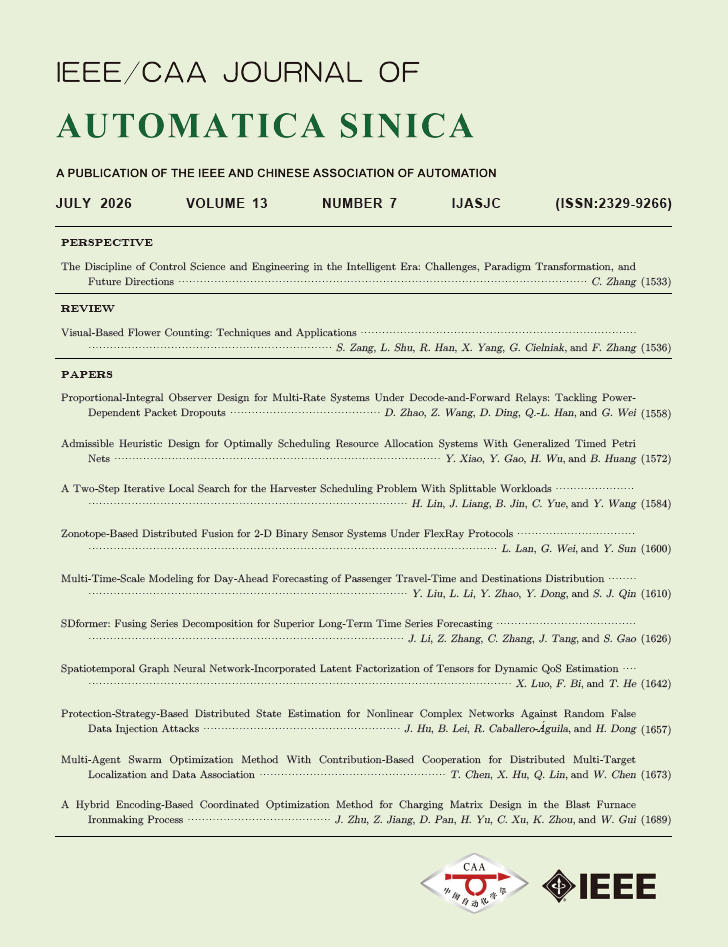 Volume 13
Issue 7
Volume 13
Issue 7
IEEE/CAA Journal of Automatica Sinica
| Citation: | X. Luo, F. Bi, and T. He, “Spatiotemporal graph neural network-incorporated latent factorization of tensors for dynamic QoS estimation,” IEEE/CAA J. Autom. Sinica, vol. 13, no. 7, pp. 1642–1656, Jul. 2026. doi: 10.1109/JAS.2025.125750

|

1 Supplementary Material of this paper can be found in link https://www.ieee-jas.com/article/doi/10.1109/JAS.2025.125750?pageType=en#Supplements
| [1] |
Y. Wang, Y. Tian, J. Wang, Y. Cao, S. Li, and B. Tian, “Integrated inspection of QoM, QoP, and QoS for AOI industries in metaverses,” IEEE/CAA J. Autom. Sinica, vol. 9, no. 12, pp. 2071–2078, Dec. 2022. doi: 10.1109/JAS.2022.106091
|
| [2] |
D. Wu, P. Zhang, Y. He, and X. Luo, “A double-space and double-norm ensembled latent factor model for highly accurate web service QoS prediction,” IEEE Trans. Serv. Comput., vol. 16, no. 2, pp. 802–814, Mar.–Apr. 2023. doi: 10.1109/TSC.2022.3178543
|
| [3] |
G. Zou, S. Wu, S. Hu, C. Cao, Y. Gan, B. Zhang, and Y. Chen, “NCRL: Neighborhood-based collaborative residual learning for adaptive QoS prediction,” IEEE Trans. Serv. Comput., vol. 16, no. 3, pp. 2030–2043, May–Jun. 2023.
|
| [4] |
W. J. Huang, P. Y. Zhang, Y. T. Chen, M. C. Zhou, Y. Al-Turki, and A. Abusorrah, “QoS prediction model of cloud services based on deep learning,” IEEE/CAA J. Autom. Sinica, vol. 9, no. 3, pp. 564–566, Mar. 2022. doi: 10.1109/JAS.2021.1004392
|
| [5] |
F. Bi, T. He, Y. Xie, and X. Luo, “Two-stream graph convolutional network-incorporated latent feature analysis,” IEEE Trans. Serv. Comput., vol. 16, no. 4, pp. 3027–3042, Jul.–Aug. 2023. doi: 10.1109/TSC.2023.3241659
|
| [6] |
Y.-Y. Fanjiang, Y. Syu, and W.-L. Huang, “Time series QoS forecasting for web services using multi-predictor-based genetic programming,” IEEE Trans. Serv. Comput., vol. 15, no. 3, pp. 1423–1435, May–Jun. 2022. doi: 10.1109/TSC.2020.2994136
|
| [7] |
F. Bi, T. He, and X. Luo, “A fast nonnegative autoencoder-based approach to latent feature analysis on high-dimensional and incomplete data,” IEEE Trans. Serv. Comput., vol. 17, no. 3, pp. 733–746, May–Jun. 2024. doi: 10.1109/TSC.2023.3319713
|
| [8] |
K. Liu, F. Xue, X. He, D. Guo, and R. Hong, “Joint multi-grained popularity-aware graph convolution collaborative filtering for recommendation,” IEEE Trans. Comput. Soc. Syst., vol. 10, no. 1, pp. 72–83, Feb. 2023. doi: 10.1109/TCSS.2022.3151822
|
| [9] |
D. Wu, X. Luo, M. Shang, Y. He, G. Wang, and X. Wu, “A data-characteristic-aware latent factor model for web services QoS prediction,” IEEE Trans. Knowl. Data Eng., vol. 34, no. 6, pp. 2525–2538, Jun. 2022.
|
| [10] |
J. Hu, B. Hooi, S. Qian, Q. Fang, and C. Xu, “MGDCF: Distance learning via Markov graph diffusion for neural collaborative filtering,” IEEE Trans. Knowl. Data Eng., vol. 36, no. 7, pp. 3281–3296, Jul. 2024. doi: 10.1109/TKDE.2023.3348537
|
| [11] |
T. Zhu, L. Sun, and G. Chen, “Embedding disentanglement in graph convolutional networks for recommendation,” IEEE Trans. Knowl. Data Eng., vol. 35, no. 1, pp. 431–442, Jan. 2023. doi: 10.1109/tkde.2021.3087791
|
| [12] |
X. Luo, H. Wu, H. Yuan, and M. C. Zhou, “Temporal pattern-aware QoS prediction via biased non-negative latent factorization of tensors,” IEEE Trans. Cybern., vol. 50, no. 5, pp. 1798–1809, May 2020. doi: 10.1109/TCYB.2019.2903736
|
| [13] |
Y. Yuan, X. Luo, M. Shang, and Z. Wang, “A Kalman-filter-incorporated latent factor analysis model for temporally dynamic sparse data,” IEEE Trans. Cybern., vol. 53, no. 9, pp. 5788–5801, Sep. 2023. doi: 10.1109/TCYB.2022.3185117
|
| [14] |
R. Jiang, Z. Wang, J. Yong, P. Jeph, Q. Chen, Y. Kobayashi, X. Song, S. Fukushima, and T. Suzumura, “Spatio-temporal meta-graph learning for traffic forecasting,” in Proc. 37th AAAI Conf. Artificial Intelligence, Washington, USA, 2023, pp. 8078−8086.
|
| [15] |
A. Pareja, G. Domeniconi, J. Chen, T. Ma, T. Suzumura, H. Kanezashi, T. Kaler, T. B. Schardl, and C. E. Leiserson, “EvolveGCN: Evolving graph convolutional networks for dynamic graphs,” in Proc. 34th AAAI Conf. Artificial Intelligence, New York, USA, 2020, pp. 5363−5370.
|
| [16] |
J. Gao and B. Ribeiro, “On the equivalence between temporal and static equivariant graph representations,” in Proc. 39th Int. Conf. Machine Learning, Baltimore, USA, 2022, pp. 7052−7076.
|
| [17] |
J. Zhou, D. Ding, Z. Wu, and Y. Xiu, “Spatial context-aware time-series forecasting for QoS prediction,” IEEE Trans. Netw. Serv. Manag., vol. 20, no. 2, pp. 918–931, Jun. 2023. doi: 10.1109/TNSM.2023.3250512
|
| [18] |
Y. Sun, X. Jiang, Y. Hu, F. Duan, K. Guo, B. Wang, J. Gao, and B. Yin, “Dual dynamic spatial-temporal graph convolution network for traffic prediction,” IEEE Trans. Intell. Transp. Syst., vol. 23, no. 12, pp. 23680–23693, Dec. 2022. doi: 10.1109/TITS.2022.3208943
|
| [19] |
A. Cini, I. Marisca, F. M. Bianchi, and C. Alippi, “Scalable spatiotemporal graph neural networks,” in Proc. 37th AAAI Conf. Artificial Intelligence, Washington, USA, 2023, pp. 7218−7226.
|
| [20] |
W. Cong, S. Zhang, J. Kang, B. Yuan, H. Wu, X. Zhou, H. Tong, and M. Mahdavi, “Do we really need complicated model architectures for temporal networks?” in Proc. 11th Int. Conf. Learning Representations, Kigali, Rwanda, 2023, pp. 1−27.
|
| [21] |
M. Zhu, X. Wang, C. Shi, H. Ji, and P. Cui, “Interpreting and unifying graph neural networks with an optimization framework,” in Proc. Web Conf., Ljubljana, Slovenia, 2021, pp. 1215−1226.
|
| [22] |
A. Zhang, W. Ma, J. Zheng, X. Wang, and T.-S. Chua, “Robust collaborative filtering to popularity distribution shift,” ACM Trans. Inf. Syst., vol. 42, no. 3, Art. no. 80, May 2024. doi: 10.1145/3627159
|
| [23] |
T. Kong, T. Kim, J. Jeon, J. Choi, Y.-C. Lee, N. Park, and S.-W. Kim, “Linear, or non-linear, that is the question!” in Proc. 15th ACM Int. Conf. Web Search and Data Mining, Tempe, USA, 2022, pp. 517−525.
|
| [24] |
X. He, K. Deng, X. Wang, Y. Li, Y. D. Zhang, and M. Wang, “LightGCN: Simplifying and powering graph convolution network for recommendation,” in Proc. 43rd Int. ACM SIGIR Conf. Research and Development in Information Retrieval, Xi’an, China, 2020, pp. 639−648.
|
| [25] |
O. A. Malik, S. Ubaru, L. Horesh, M. E. Kilmer, and H. Avron, “Dynamic graph convolutional networks using the tensor M-product,” in Proc. SIAM Int. Conf. Data Mining, 2021, pp. 729−737.
|
| [26] |
K. Braman, “Third-order tensors as linear operators on a space of matrices,” Linear Algebra Appl., vol. 433, no. 7, pp. 1241–1253, Dec. 2010. doi: 10.1016/j.laa.2010.05.025
|
| [27] |
M. E. Kilmer, L. Horesh, H. Avron, and E. Newman, “Tensor-tensor algebra for optimal representation and compression of multiway data,” Proc. Natl. Acad. Sci. USA, vol. 118, no. 28, Art. no. e2015851118, Jul. 2021. doi: 10.1073/pnas.2015851118
|
| [28] |
N. Zeng, X. Li, P. Wu, H. Li, and X. Luo, “A novel tensor decomposition-based efficient detector for low-altitude aerial objects with knowledge distillation scheme,” IEEE/CAA J. Autom. Sinica, vol. 11, no. 2, pp. 487–501, Feb. 2024. doi: 10.1109/JAS.2023.124029
|
| [29] |
T. Sun, C. Wang, H. Dong, Y. Zhou, and C. Guan, “A novel parameter-optimized recurrent attention network for pipeline leakage detection,” IEEE/CAA J. Autom. Sinica, vol. 10, no. 4, pp. 1064–1076, Apr. 2023. doi: 10.1109/JAS.2023.123180
|
| [30] |
T. He, Y.-S. Ong, and L. Bai, “Learning conjoint attentions for graph neural nets,” in Proc. 35th Int. Conf. Neural Information Processing Systems, 2021, Art. no. 202.
|
| [31] |
K. Xu, W. Hu, J. Leskovec, and S. Jegelka, “How powerful are graph neural networks?” in Proc. 7th Int. Conf. Learning Representations, New Orleans, USA, 2019, pp. 1−17.
|
| [32] |
Q. Zhu, Q. Xiong, Z. Yang, and Y. Yu, “RGCNU: Recurrent graph convolutional network with uncertainty estimation for remaining useful life prediction,” IEEE/CAA J. Autom. Sinica, vol. 10, no. 7, pp. 1640–1642, Jul. 2023. doi: 10.1109/JAS.2023.123369
|
| [33] |
J. Liu, C. Xu, C. Yin, W. Wu, and Y. Song, “K-core based temporal graph convolutional network for dynamic graphs,” IEEE Trans. Knowl. Data Eng., vol. 34, no. 8, pp. 3841–3853, Aug. 2022. doi: 10.1109/TKDE.2020.3033829
|
| [34] |
Y. Shin and Y. Yoon, “PGCN: Progressive graph convolutional networks for spatial–temporal traffic forecasting,” IEEE Trans. Intell. Transp. Syst., vol. 25, no. 7, pp. 7633–7644, Jul. 2024. doi: 10.1109/TITS.2024.3349565
|
| [35] |
T. He, Y. Liu, Y.-S. Ong, X. Wu, and X. Luo, “Polarized message-passing in graph neural networks,” Artif. Intell., vol. 331, Art. no. 104129, Jun. 2024. doi: 10.1016/j.artint.2024.104129
|
| [36] |
H. Zhou, T. He, Y.-S. Ong, G. Cong, and Q. Chen, “Differentiable clustering for graph attention,” IEEE Trans. Knowl. Data Eng., vol. 36, no. 8, pp. 3751–3764, Aug. 2024.
|
| [37] |
H. Zhou, W. Huang, Y. Chen, T. He, G. Cong, and Y.-S. Ong, “Road network representation learning with the third law of geography,” in Proc. 38th Int. Conf. Neural Information Processing Systems, Vancouver, Canada, 2024, Art. no. 376.
|
| [38] |
D. P. Kingma and J. Ba, “Adam: A method for stochastic optimization,” in Proc. 3rd Int. Conf. Learning Representations, San Diego, USA, 2015.
|
| [39] |
F. Bi, X. Luo, B. Shen, H. Dong, and Z. Wang, “Proximal alternating-direction-method-of-multipliers-incorporated nonnegative latent factor analysis,” IEEE/CAA J. Autom. Sinica, vol. 10, no. 6, pp. 1388–1406, Jun. 2023. doi: 10.1109/JAS.2023.123474
|
| [40] |
F. Manessi, A. Rozza, and M. Manzo, “Dynamic graph convolutional networks,” Pattern Recognit., vol. 97, Art. no. 107000, Jan. 2020. doi: 10.1016/j.patcog.2019.107000
|
| [41] |
X. Wang, D. Lyu, M. Li, Y. Xia, Q. Yang, X. Wang, P. Cui, Y. Yang, B. Sun, and Z. Guo, “APAN: Asynchronous propagation attention network for real-time temporal graph embedding,” in Proc. Int. Conf. Management of Data, China, 2021, pp. 2628−2638.
|
| [42] |
M. Bhanu, J. Mendes-Moreira, and J. Chandra, “Embedding traffic network characteristics using tensor for improved traffic prediction,” IEEE Trans. Intell. Transp. Syst., vol. 22, no. 6, pp. 3359–3371, Jun. 2021. doi: 10.1109/TITS.2020.2984175
|
| [43] |
V. N. Ioannidis, A. S. Zamzam, G. B. Giannakis, and N. D. Sidiropoulos, “Coupled graphs and tensor factorization for recommender systems and community detection,” IEEE Trans. Knowl. Data Eng., vol. 33, no. 3, pp. 909–920, Mar. 2021.
|
| [44] |
X. Liu, M. Yan, L. Deng, G. Li, X. Ye, and D. Fan, “Sampling methods for efficient training of graph convolutional networks: A survey,” IEEE/CAA J. Autom. Sinica, vol. 9, no. 2, pp. 205–234, Feb. 2022. doi: 10.1109/JAS.2021.1004311
|
| [45] |
R. Wang, Z. Zhou, K. Li, T. Zhang, L. Wang, X. Xu, and X. Liao, “Learning to branch in combinatorial optimization with graph pointer networks,” IEEE/CAA J. Autom. Sinica, vol. 11, no. 1, pp. 157–169, Jan. 2024. doi: 10.1109/JAS.2023.124113
|
 JAS-2025-0022-Supplementary Materials.pdf
|

|
Figures(10) / Tables(4)






 DownLoad: